
The U.S. economy has gone through major changes over the past two presidencies. Growth, inflation, trade, and jobs moved in different directions under two different policy approaches.
This article explains the key economic differences between the Trump and Biden eras using publicly tracked data. It does not argue who performed better. Instead, it focuses on what changed, why it changed, and what experts track when measuring economic results.
Recent statements by Donald Trump on the U.S. economy have also drawn attention to growth, trade, and inflation trends.
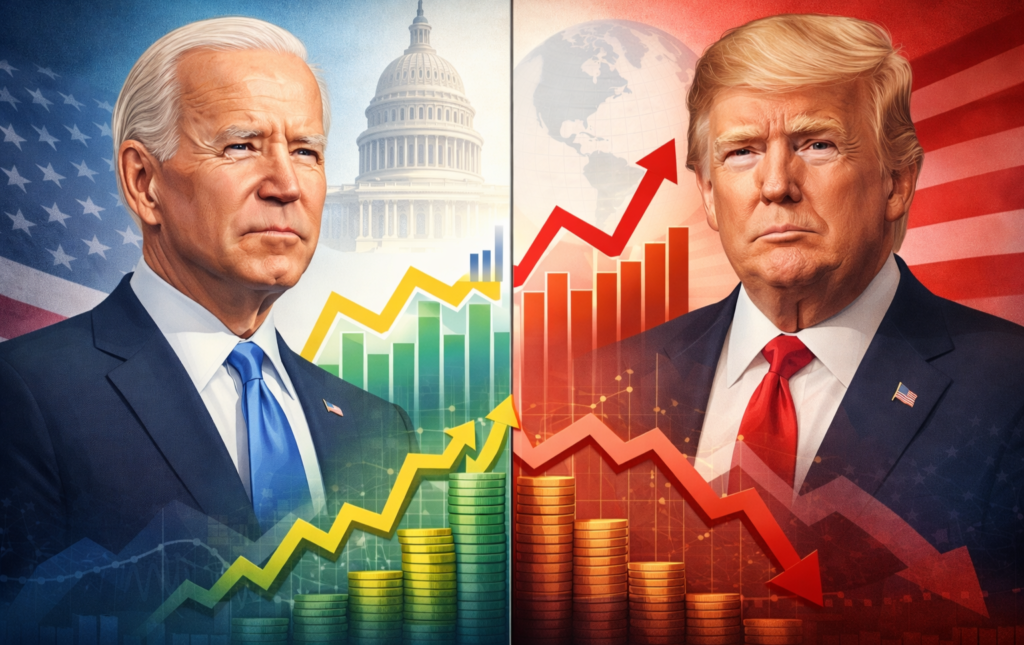
Trump Era: Growth, Trade, and Inflation (2017–2020)
During the presidency of Donald J. Trump, economic growth followed trends that began earlier but were shaped by tax cuts and trade policy.
Economic growth
Between 2017 and 2019, U.S. GDP grew at a steady pace, mostly between 2% and 3% per year. Growth was supported by strong consumer spending and higher business investment after the 2017 tax reform.
In 2020, the COVID-19 pandemic caused a sharp economic contraction. GDP fell rapidly in the second quarter before rebounding later in the year. Economists generally view this period as a crisis-driven shock rather than a normal economic slowdown.
Trade and tariffs
Trade policy was a central feature of this era. Tariffs were added to imports from China and other countries, aiming to reduce trade imbalances and protect domestic industries.
The U.S. trade deficit narrowed at certain points but remained sensitive to global demand, supply chain conditions, and currency movements. During the pandemic, both imports and exports declined sharply as global trade slowed.
Inflation trends
Inflation remained low and stable from 2017 through early 2020. Consumer price increases stayed close to the Federal Reserve’s long-term target. Lower energy prices and steady global demand helped keep inflation under control.
Biden Era: Inflation, Jobs, and Government Spending (2021–Present)
Under Joe Biden, the economy reopened after the pandemic while facing new pressures linked to supply disruptions and rising prices.
Inflation and prices
Inflation rose sharply in 2021 and 2022 as consumer demand recovered faster than supply. Energy costs, housing, and food prices increased at a pace not seen in decades.
Over time, inflation began to slow as supply chains improved and interest rates increased. Price growth remained uneven across sectors, affecting households differently depending on income and spending patterns.
Jobs and the labour market
Job growth accelerated during the early part of this period as businesses reopened. Millions of jobs lost during the pandemic were gradually recovered.
Unemployment fell to historically low levels, although labour participation rates changed due to retirements and demographic shifts. Wage growth increased, especially in lower-paying industries.
Government spending
Lawmakers approved large federal spending packages to support households, infrastructure projects, and clean energy investment. These measures aimed to stabilise the recovery and support long-term economic growth.
Economists continue to debate how much this spending boosted growth versus how much it contributed to inflation pressures.
Key Differences at a Glance
A side-by-side overview of growth, inflation, trade, and jobs during both presidencies.
| Area | Trump Era | Biden Era |
| GDP growth | Steady before the pandemic, sharp drop in 2020 | Recovery growth after the pandemic |
| Inflation | Low and stable | Sharp rise, then gradual cooling |
| Trade policy | Tariffs and trade disputes | Fewer tariffs, focus on the supply chains |
| Job market | Low unemployment before 2020 | Rapid job recovery after 2020 |
| Government Spending | Tax cuts, limited stimulus | Large recovery and infrastructure spending |
What Experts Track When Measuring the Economy
Economists rely on several key indicators to assess economic health, regardless of political leadership.
Gross Domestic Product (GDP)
GDP measures total economic output. Experts focus on long-term trends rather than single quarters to avoid drawing misleading conclusions.
Inflation (CPI and PCE)
Inflation data shows how quickly prices rise. Analysts often study core inflation to remove short-term price swings caused by energy or food costs.
Jobs and wages
Employment data shows how many people are working and how much they earn. Labour participation rates help explain shortages, wage pressure, and long-term workforce changes.
Trade balance
Trade figures show how the U.S. interacts with the global economy. Trade deficits and surpluses depend on consumer demand, currency values, and global economic conditions.
Why the Differences Matter
Economic outcomes shape household costs, business decisions, and government policy. Understanding what changed and why helps readers separate data from political messaging.
No single administration controls all economic forces. Global events, technology, demographics, and unexpected shocks all play major roles in shaping results.